Online-calculator for volatile compound concentrations in standard solutions (RU)
The first important step in implementing methods for analyzing alcoholic beverages is the preparation of standard solutions (SS) and the accurate calculation of certified values for the concentration of volatile compounds in these solutions.
The web program "Online-calculator" provides quick and accurate calculations of component concentrations in calibration solutions in units of mg/dm3 based on anhydrous ethyl alcohol (mg/dm3 AA) in accordance with the manual "Methodology for measuring the mass concentration of aldehydes, esters, methyl alcohol, and higher alcohols in alcohol-containing products using gas chromatography" (RU) .
Brief description of the methodology and "Online-calculator" (RU)
The method is suitable for gas chromatographic determination of the following volatile microimpurities in ethyl alcohol from food raw materials, alcoholic products, alcoholic and low-alcohol beverages, wine products and alcohol-containing food products: aldehydes (ethanal (acetaldehyde)), esters (methyl ethanoate (methyl acetate), ethyl ethanoate (ethyl acetate)), methanol (methyl alcohol) and higher alcohols (propan-2-ol (sec-propyl alcohol)), propan-1-ol (n-propyl alcohol), 2-methylpropan-1-ol (isobutyl alcohol), butan-1-ol (n-butyl alcohol), 3-methylbutan-1-ol (isoamyl alcohol) (in the range from 0.5 to 10,000 mg/dm3 AA).
Ethyl alcohol present in the test samples is used as an internal standard as a reference substance.
To prepare SS, use reagents with a purity (P, %) of at least 99.0%, with a certificate of purity.
To work according to the method, the following SS of volatile components are prepared:
- 40% v/v water-ethanol solution (WES),
- "Stock" concentrated SS-A,
- SS-C for establishing RRF calibration coefficients,
- SS for monitoring the linearity of the detector response (B, D, 1, 2, 3).
Necessary initial data for the calculator to work:
- mass of components added to the SS during preparation,
- strength and density of water-ethanol solution (WES),
- chromatographic data for calibration SS-C and for WES.
Jump to the "Online-calculator" (RU)
To the "Online-calculator" (RU)The calculator has a "Main Menu" for navigation.
The "Guide" tab contains a complete guide (RU) on preparing calibration solutions, calculating the concentrations of volatile components in these solutions, and calibration coefficients. Recommended reagent masses for preparing solutions are provided, as well as all the calculation formulas used in the web application.
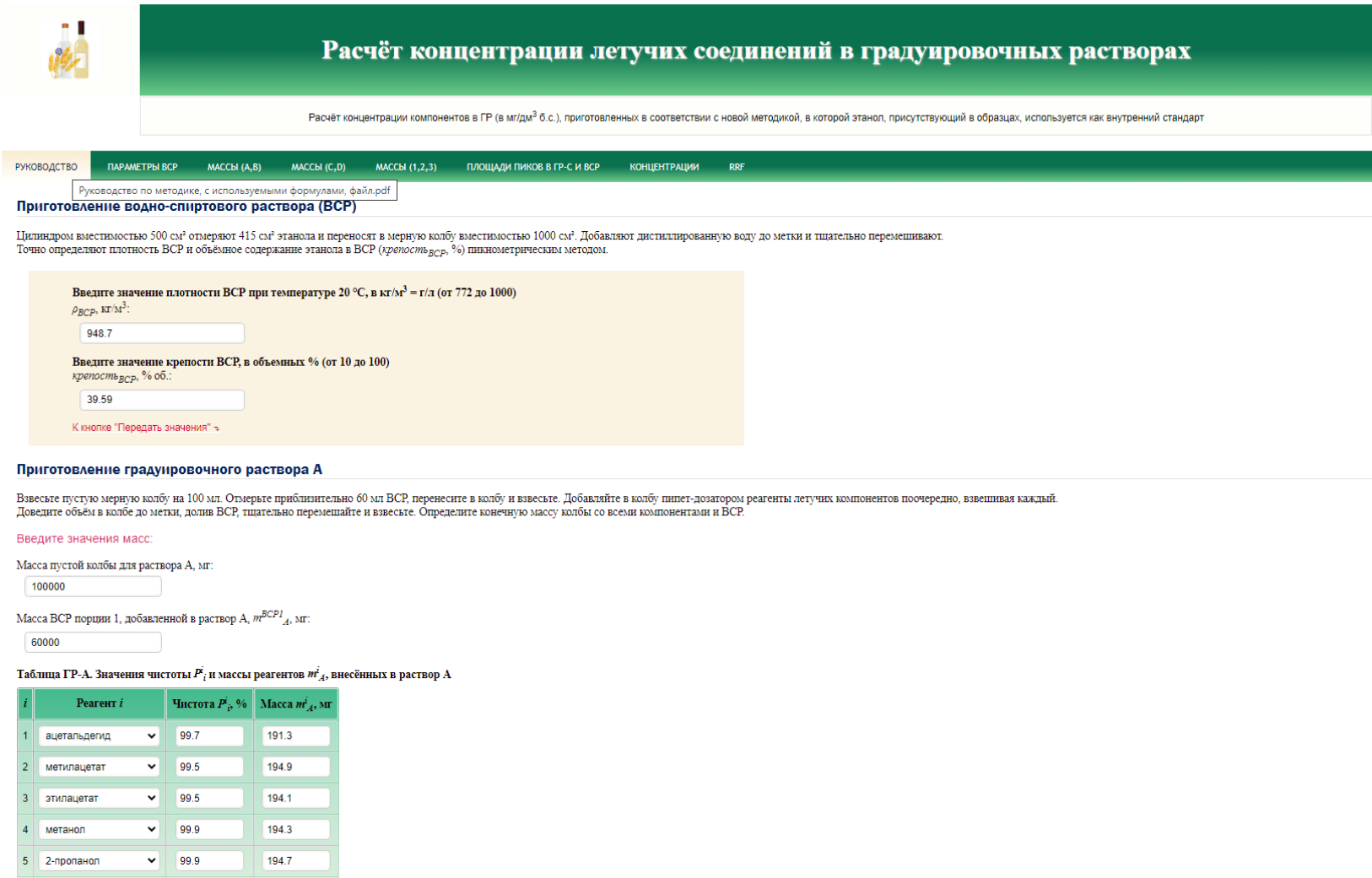 |
A copy of the online-calculator start screen is shown. A single "Click to submit" button is used to transfer user-entered data to the calculator. Calculation results can be saved as HTML, PDF, or downloaded in TXT format. An example of a completed and saved PDF file is here (RU). |
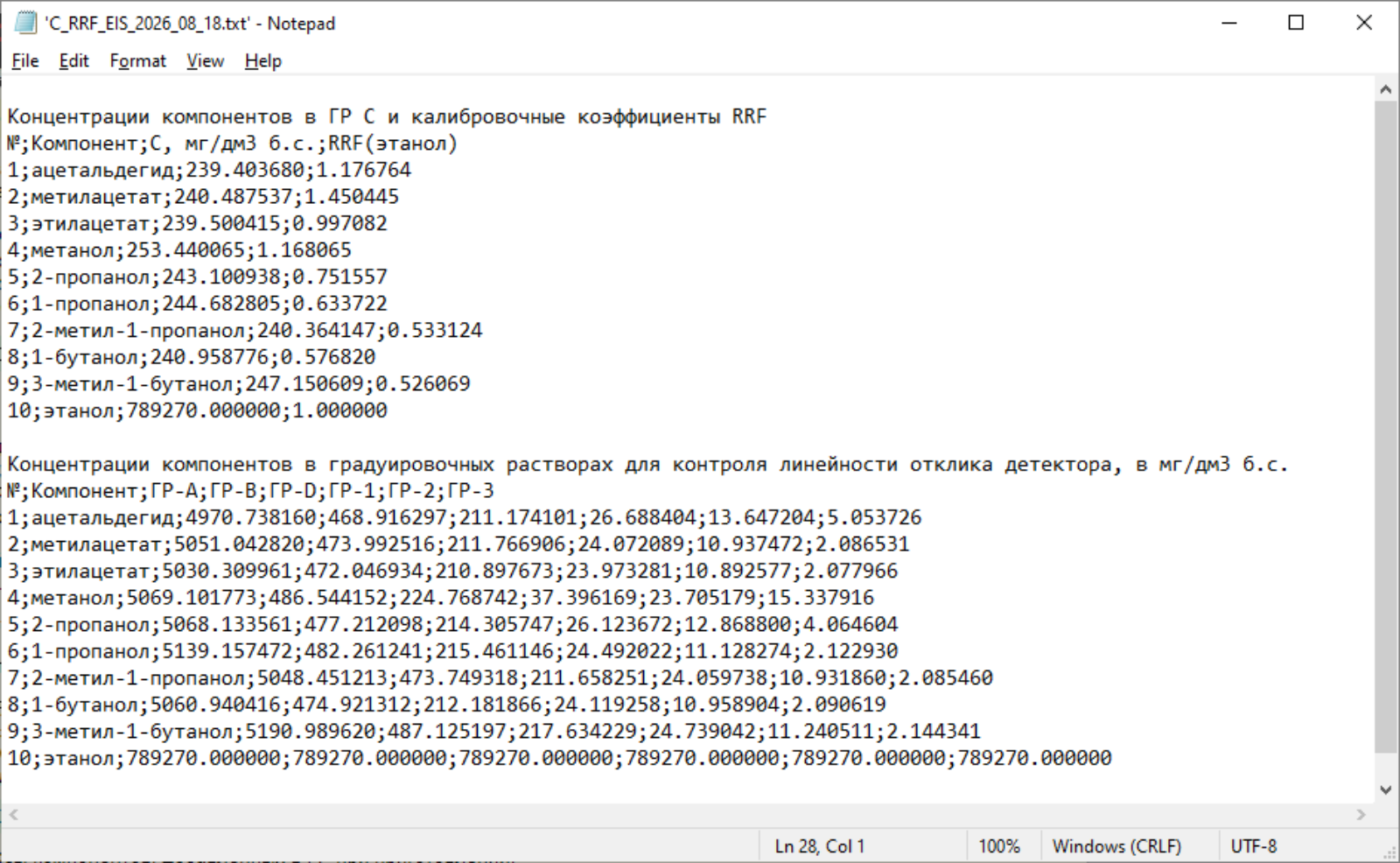 |
Example of a downloaded data file *.txt |
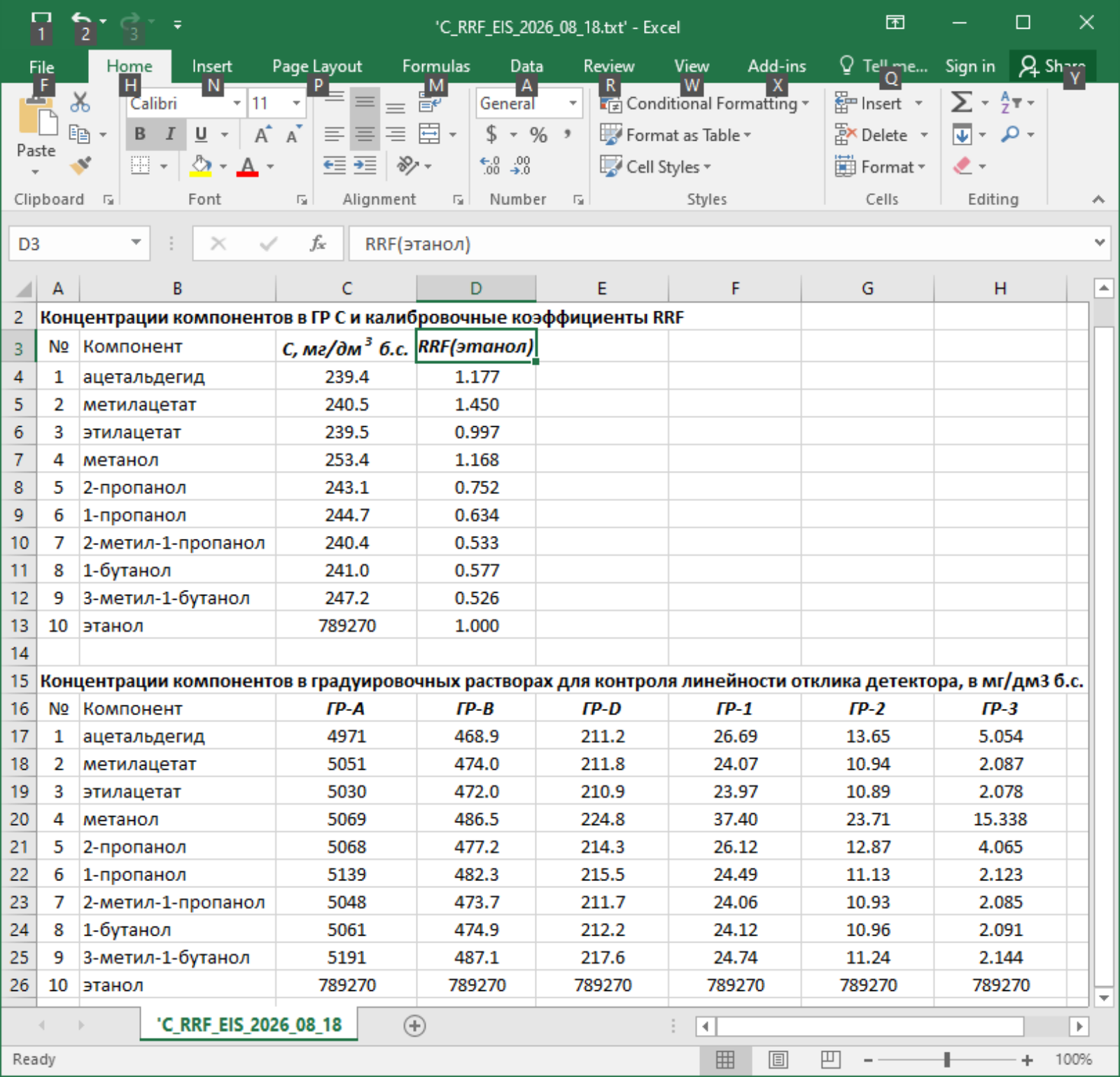 |
The downloaded txt file can be easily opened in Excel by using a semicolon as the data separator. |