Online calculator of alcoholic beverages using 3 methods
This program is designed for working with archived data obtained during gas chromatographic analysis of alcoholic beverages (wines, spirits drinks, other spirits) using any calibration method. The calculator is designed for a comparative evaluation of the metrological parameters which characterized the three types of methods:
- the new modified internal standard method (IS_Ethanol), in which ethanol present in the samples is used as internal standard,
- the traditional internal standard method (using an additionally added reference substance),
- the external standard method (absolute calibration).
The required initial data for the calculator operation is:
- known certified values Ccert of component concentrations in standard solutions (SS),
- chromatogram data of SS and samples of alcoholic beverages.
The initial stage of all methods is calibration using information about the certified concentration values Ccert of volatile compounds in SS. Next, using the established calibration coefficients, the content of volatile congeners Cmeas is determined in the analyzed samples.
Brief description of the calculator's capabilities and functions
The methods are suitable for gas chromatographic determination of the following volatile microimpurities in alcoholic and low-alcohol beverages, spirits, wine, wine products and alcohol-containing food products: aldehydes (ethanal (acetaldehyde)), esters (methyl ethanoate (methyl acetate), ethyl ethanoate (ethyl acetate)), acetal, methanol (methyl alcohol) and higher alcohols (2-propanol, 2-butanol, n-propanol, 2-methyl-1-propanol, n-butanol, 2-methyl-1-butanol, 3-methyl-1-butanol) with analyte content ranging from 5 to 1500 g per 100 L anhydrous ethanol (g/100 L AA).
The calculator supports the following units for certified values of SS compound concentration and for results of measurement (AA - anhydrous alcohol): mg/L (mg/L = mg/dm3), mg/L AA, vol.%, vol.% AA, g/100L AA (g/100L AA = mg/100cm3 AA), µg/g.
In the "IS_Ethanol" method, calculations are performed per AA, therefore, the following units of measurement are possible for working with "IS_Ethanol": mg/L AA, %vol. AA, g/100L AA, mg/100cm3 AA.
To convert concentration values from one unit of measurement to another, the density of the samples and the volumetric ethanol content of the samples may be required. If both the "primary" and "final" units of measurement are calculated per AA, then information about the strength and the density of SS and product samples is not required.
To evaluate metrological characteristics, the calculator allows using one, two or three calibration methods simultaneously:
- calculate the concentrations of compounds Cmeas in SS using chromatogram data,
- compare Cmeas with certified concentration values Ccert by estimating the magnitude of the bias (in %),
- determine the values of the standard deviation (SD) and the relative standard deviation (RSD) for these solutions,
- determine the values of the response linearity coefficients - the determination coefficient R2,
- determine the values of the response linearity coefficients - the linear correlation coefficient Cp.
For product samples, the calculator allows using one, two or three calibration methods simultaneously:
- calculate the concentrations of compounds Cmeas in samples,
- determine the standard deviation (SD),
- calculate relative standard deviation (RSD).
Selecting axes for calibration and linearity testing of FID
In various regulatory documents on chromatographic analysis methods and software products for chromatography, the following types of calibration dependencies are encountered:
- dependences of concentration values (the ratio of analyte and internal standard concentrations) on the compounds peak area (the ratio of the analyte and internal standard peak areas) - these dependencies are denoted by C/A ;
- dependences of compounds peak area values (the ratio of the analyte and internal standard peak areas) on the concentration (the ratio of the analyte and internal standard concentrations) - these dependencies are denoted by A/C;
- external standar uses concentration values and compounds peak area;
- internal standard uses the ratio of analyte and internal standard concentrations and the ratio of the analyte and internal standard peak areas.
Thus, there are three version of "Online-calculator of alcoholic beverages using 3 methods": C/A, A/C and the both C/A and A/C calibrations.
Jump to the "Online calculator of alcoholic beverages using 3 methods"
There are three version of "Online calculator of alcoholic beverages using 3 methods" program:
Jump to the "Online-calculator of alcoholic beverages using 3 methods (axes C/A)"Jump to the "Online-calculator of alcoholic beverages using 3 methods (axes A/C)"
Jump to the "Online-calculator of alcoholic beverages using 3 methods (axes C/A and A/C)"
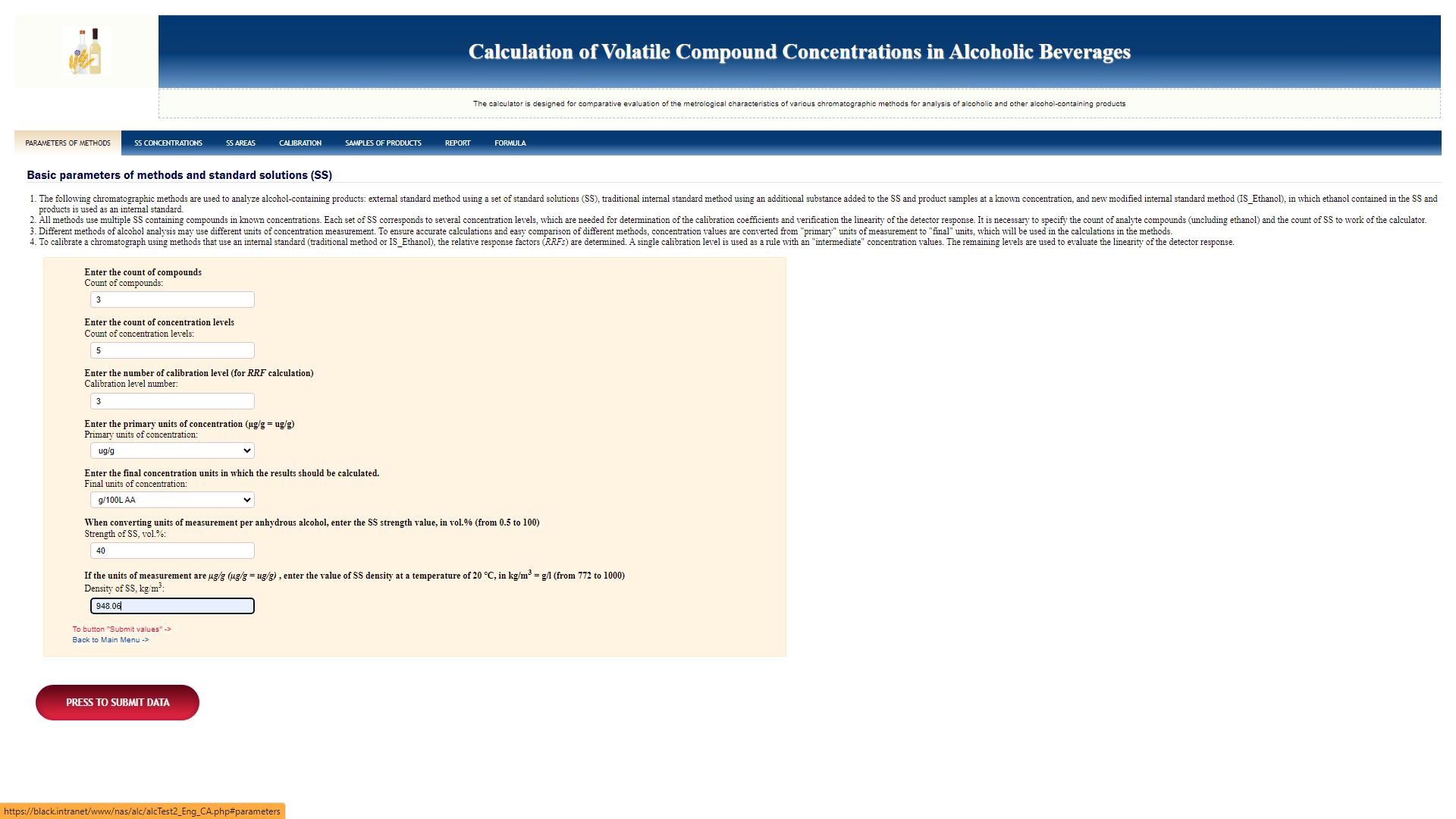 |
A copy of the online-calculator start screen is shown. The calculator has a "Main Menu" for navigation. To transfer user-entered data into the calculator, press the button "Press to Submit Data". Calculation results can be saved as HTML or PDF. An example of a completed and saved PDF file is here. |
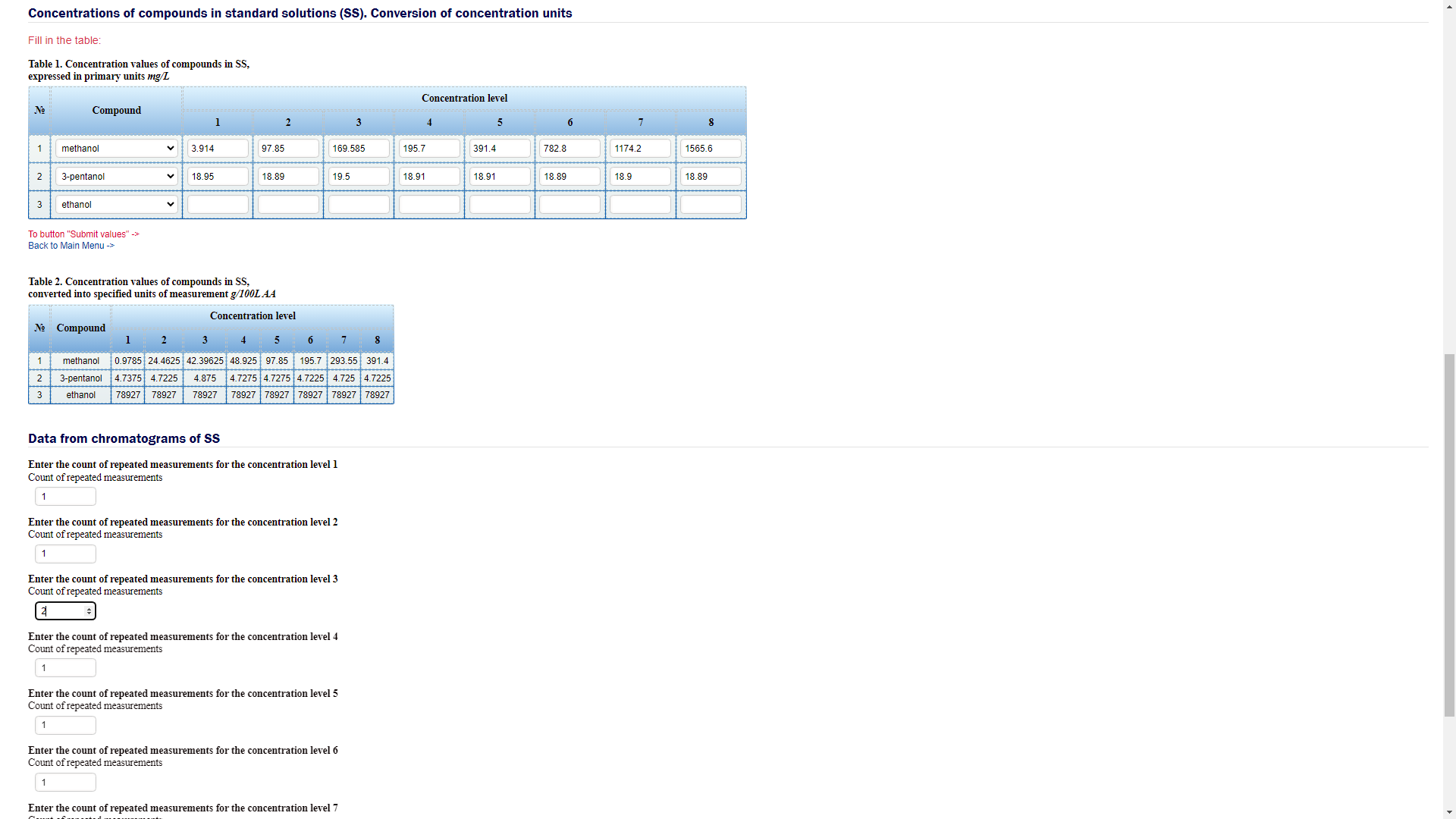 |
Example of a copy of the online-calculator screen with tables of compound concentration in SS |
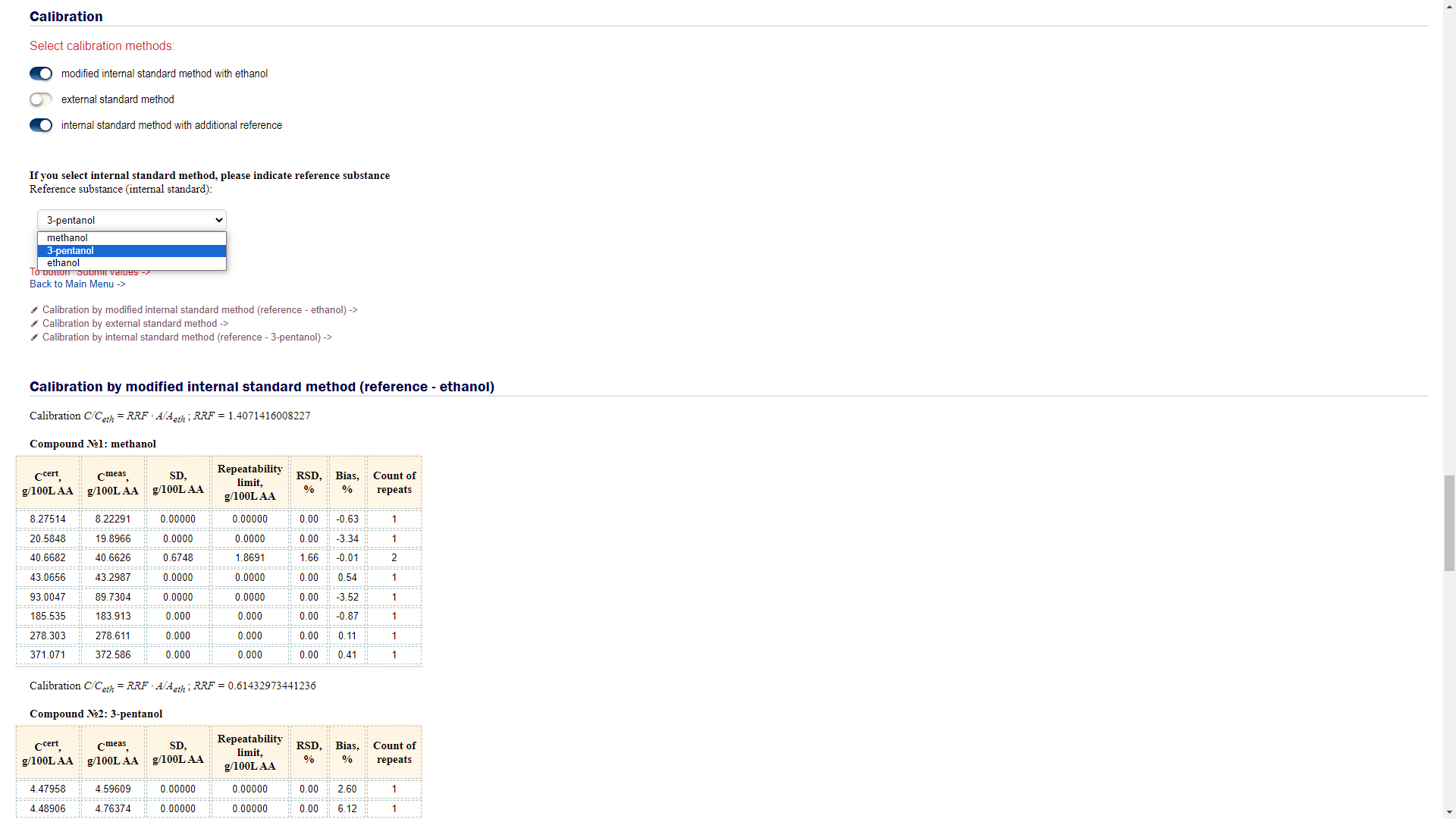 |
Example of a copy of the online-calculator screen with calibration setting |
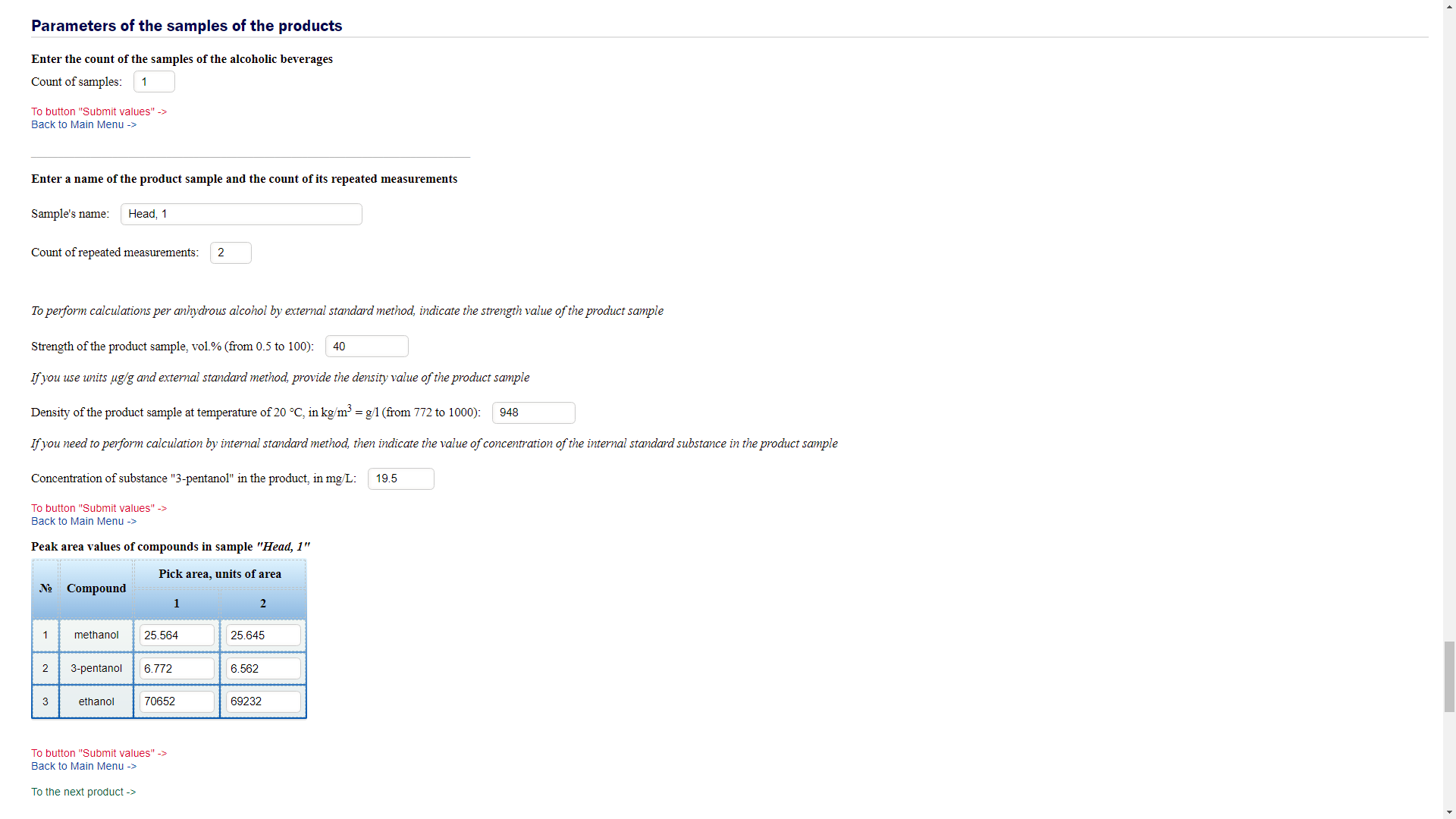 |
Example of a copy of the online-calculator screen with parameters of a sample |
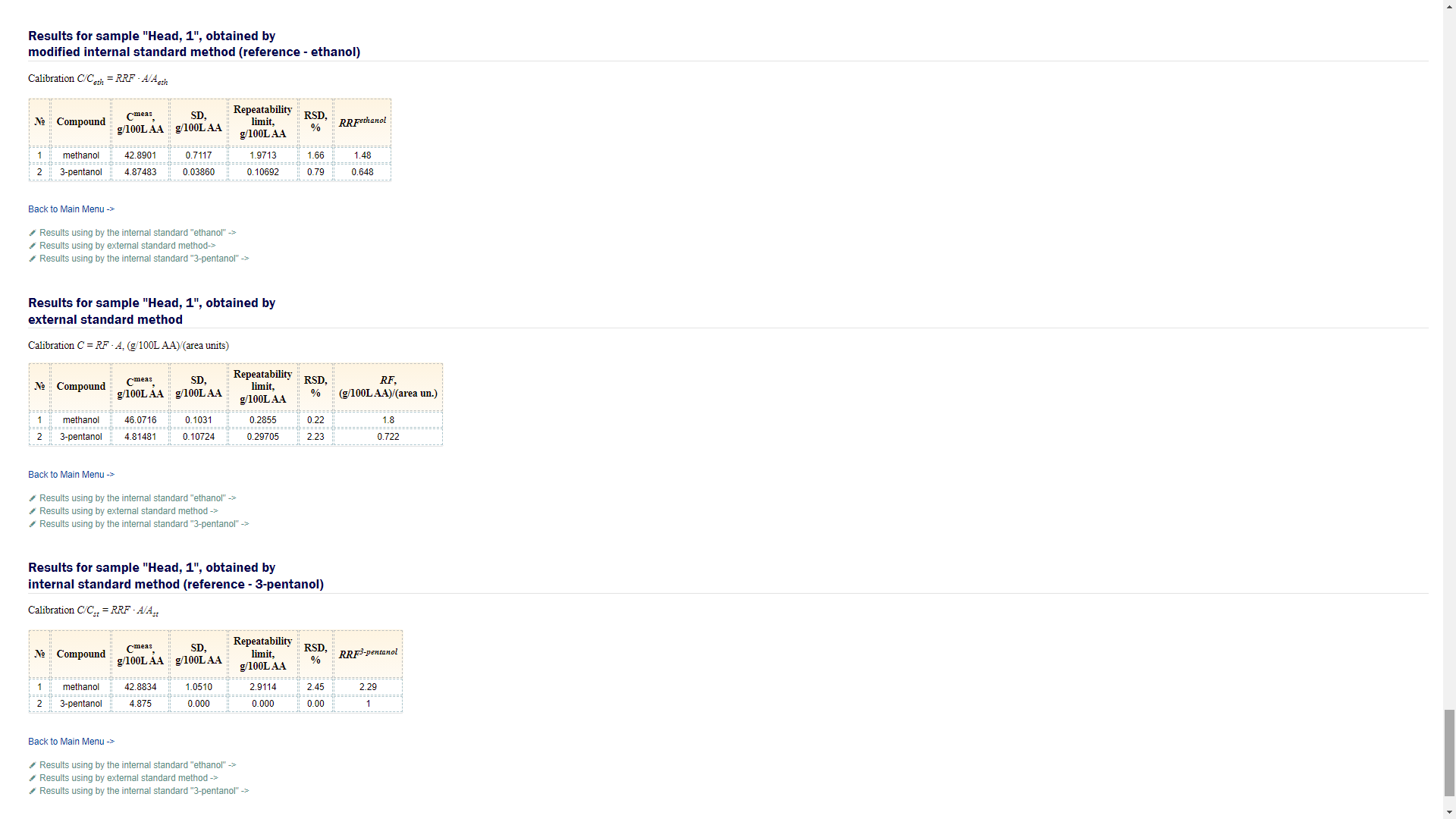 |
Example of a copy of the online-calculator screen with results for a sample |